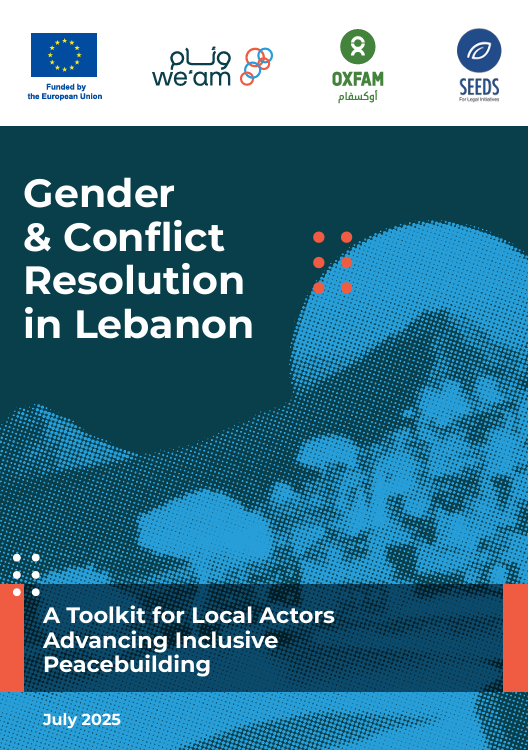
Gender & Conflict Resolution in Lebanon: A Toolkit for Local Actors Advancing Inclusive Peacebuilding
Background
Lebanon’s long history of conflict, political instability, and overlapping crises has deepened gender inequalities and restricted women’s participation in political, economic, and peacebuilding processes. Structural discrimination, reinforced by patriarchal norms, fragmented legal systems, and recurring episodes of violence, continues to limit women’s access to decision-making spaces. The 2019 economic collapse and the 2020 Beirut port explosion further marginalized women, whose needs and leadership were largely excluded from national and local recovery efforts.
Civil society organizations, women’s rights groups, and local institutions have nevertheless emerged as key actors working to advance gender-responsive peacebuilding. Yet findings from national research show persistent gaps: inconsistent gender-sensitive policies, limited safety mechanisms for women, superficial inclusion practices, and barriers to women’s leadership across municipalities and organizations. These gaps created the need for a standardized, context-specific toolkit.
Assignment
This toolkit was developed under the EU-funded WE’AM project as part of a broader effort to foster social cohesion and equip local communities with tools to prevent and resolve social tensions. It builds directly on the nationwide study “Applying a Gender Lens to Conflict Resolution Efforts in Lebanon – WE’AM: A Feminist Exploration of Conflict and Peacebuilding Practices in Lebanon” conducted by Seeds for Legal Initiatives, which examined how organizations working on social cohesion in Lebanon engage with women, integrate gender considerations, and support their participation in peacebuilding processes.
Drawing on this research, SEEDS for Legal Initiatives identified critical gaps in gender-sensitive conflict resolution and translated them into a practical, standardized Gender Transformative Toolkit. The four-module structure and its tools are designed to strengthen the capacities of CSOs, WROs, and municipalities to advocate for and implement gender-responsive peacebuilding initiatives, and to provide clear, actionable steps to integrate gender perspectives into policies, programs, and institutional frameworks.
Research & Development Approach
The toolkit is based on the findings of SEEDS’ report “Applying a Gender Lens to Conflict Resolution Efforts in Lebanon,” which assessed the gender sensitivity of municipalities and organizations active in conflict resolution across the country. The study used a qualitative, context-driven approach, collecting data through KIIs with women’s rights organizations, social cohesion actors, and municipalities, alongside FGDs with women engaged in peacebuilding initiatives and WE’AM partners.
The research identified key gaps in gender-sensitive conflict resolution, including structural exclusion of women, persistent patriarchal norms, limitations in internal policies and budgeting, and overreliance on quantitative participation metrics. These findings underscored the need for a standardized Gender Transformative Toolkit. In response, SEEDS designed the toolkit into four structured modules, each explicitly addressing these gaps and providing practical guidance, training support, and evaluation mechanisms for more effective gender-sensitive programming in conflict-affected areas.
Toolkit Outcomes
- Module 1 – Strengthening Internal Structures: strengthens internal gender frameworks, safety/protection mechanisms, and women’s leadership.
- Module 2 – Ensuring Quality Programming: improves gender-sensitive program design, monitoring and results measurement, indicators, and partnerships.
- Module 3 – Strengthening Project Design: supports gender-responsive project design through clearer roles, risk mitigation, and budgeting.
- Module 4 – Understanding the Linkage Between GBV and Conflict Resolution: integrates GBV–conflict dynamics into conflict resolution approaches.
Seeds for Legal Initiatives. (2025). Gender & Conflict Resolution in Lebanon: A Toolkit for Local Actors Advancing Inclusive Peacebuilding. Oxfam.